How It Works
LiTPOW gives a physical product a verifiable identity. The product carries unique credentials, while a cryptographic fingerprint of those credentials is published in a permanent, public record.
The customer does not need an app, an account, cryptocurrency, or specialized equipment. They only need the credentials supplied with the product and access to LiTPOW’s verification page.
Issue
A creator publishes a product or limited edition with unique credentials.
Publish
LiTPOW hashes the credentials and places the resulting fingerprint in a public Bitcoin transaction.
Verify
The customer enters the credentials. LiTPOW calculates the fingerprint again and checks for a matching published record.
A Traceable Publishing Structure
LiTPOW is being designed to organize products within a traceable publishing structure. The structure connects an individual product to the edition, collection, creator, and publisher that issued it.
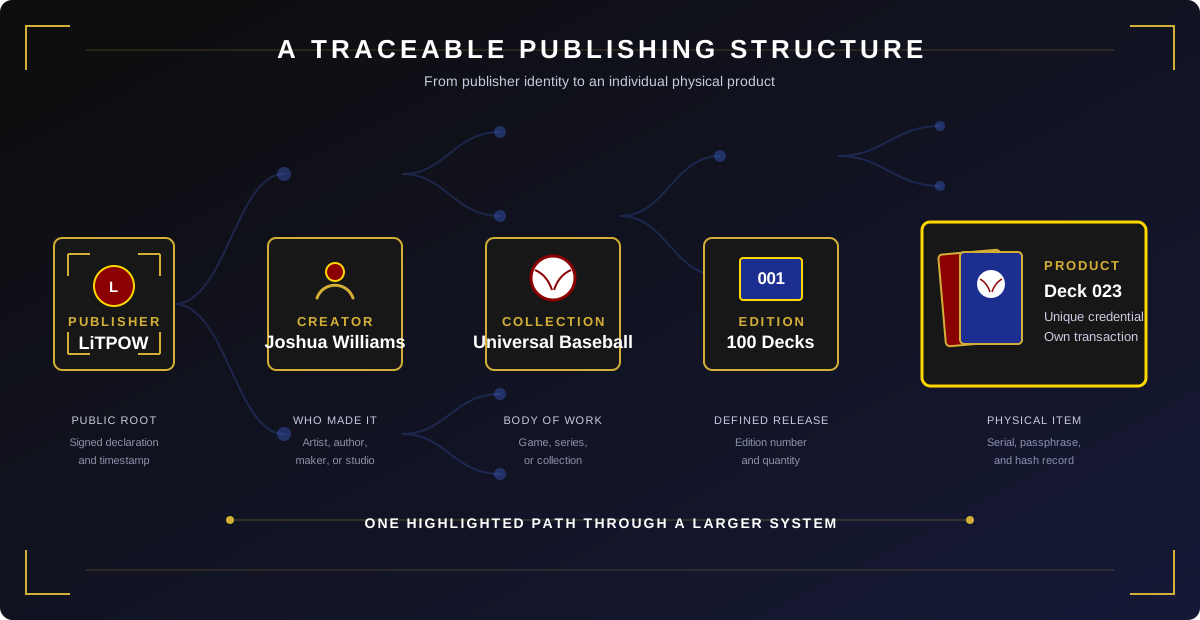
The hierarchy supplies context. Instead of finding an isolated credential with no clear origin, a customer can understand who issued it, what body of work it belongs to, which edition it came from, and which individual item it identifies.
The complete hierarchy is the direction in which LiTPOW is being developed. The current baseball implementation already establishes public anchors at the LiTPOW root, Edition 001, and each individual deck.
The Working Baseball Example
Bedard’s Universal Baseball is LiTPOW’s first published and authenticated physical product.
LiTPOW root
LiTPOW has a public Bitcoin address, public key, signed declaration, and timestamped root transaction. Together, these create an inspectable starting point for records issued by LiTPOW.
Inspect the Root Certification
Edition 001
The first edition has its own BSV address. This separates the edition’s product records from other editions and future LiTPOW projects.
100 individual decks
The edition contains 100 physical decks. Each deck has its own serial number and passphrase, and each credential pair produces a unique SHA-256 hash.
Each hash is stored as OP_RETURN data in its own transaction. The original serial number and passphrase are not placed on the public ledger.
Customer verification
When a customer enters the edition, serial number, and passphrase:
- The browser combines the serial number and passphrase.
- It calculates the same SHA-256 fingerprint used when the deck was issued.
- It retrieves transactions associated with the edition address.
- It looks for the calculated fingerprint in the OP_RETURN data.
- If a match is found, LiTPOW reports a successful credential verification.
This process is working now. You can test it with the sample credentials provided in Real or Fake? Try the Verification Yourself.
What a Successful Verification Means
A successful match provides evidence that:
- The entered credentials correspond to a fingerprint issued for the selected edition.
- The fingerprint appears in a public, timestamped blockchain transaction.
- The published record has not been silently changed after issuance.
- The underlying transaction can be inspected independently.
What It Does Not Prove by Itself
A credential match does not automatically prove:
- Who currently owns or possesses the physical item
- That the person entering the credential is authorized to use it
- That every physical component has been inspected
- That a valid credential has never been copied or disclosed
- Legal authorship, copyright ownership, or geographic origin without supporting evidence
LiTPOW is one layer in a stronger authentication process. Physical packaging, responsible handling of credentials, creator identity, and verification history can provide additional signals.
Planned Verification History
LiTPOW is also being designed to record when a valid product credential is successfully verified for the first time.
The intended result model is:
- First recorded verification: The credential is valid and LiTPOW has not previously recorded a successful check.
- Previously verified: The credential is valid, but LiTPOW has recorded an earlier successful check.
- No match: LiTPOW cannot find a published record corresponding to the supplied credentials.
- System unavailable: A technical problem prevented a determination, and no authenticity result should be inferred.
A previous verification would not prove that an item is counterfeit. It would be a reason to ask questions if the item were being sold as unopened or never previously checked.
This history feature is planned and is not part of the current public verifier.
Why Use a Public Ledger?
The verification record should not depend entirely on LiTPOW asking customers to trust a private database.
Bitcoin provides a public, timestamped record that can be inspected using independent tools. The blockchain does not determine whether a physical object is authentic. It preserves the credential fingerprint and transaction history that LiTPOW and its customers use as evidence.
The customer experience remains simple. The public ledger stays in the background unless someone wants to inspect the technical proof.
See It Work
Use a published sample credential to experience the same verification process used for the baseball edition.
Try a Sample Verification